


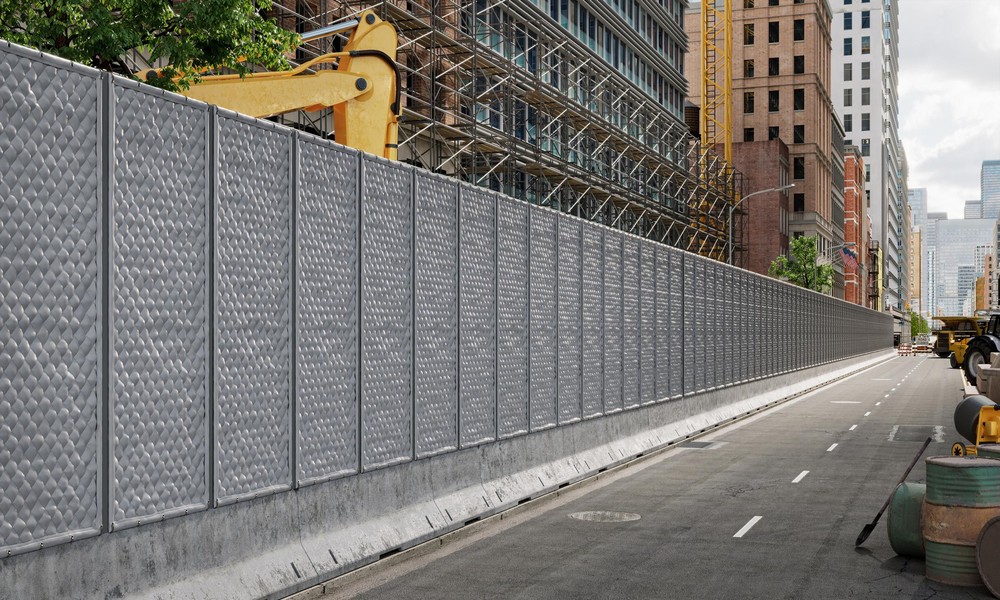
On paper, a sound barrier sounds like one of the more straightforward parts of construction planning. You install it around the site, it blocks noise from escaping, and nearby areas immediately experience less disturbance.
That’s the theory. But once you step onto a real construction site, especially in a dense urban environment, things start to feel a lot less predictable.
Noise behaves differently, the site keeps changing, and what looked effective in planning doesn’t always perform the same way in practice. That’s why the real performance of construction sound barriers often depends on factors that go far beyond the material or design itself.
Let’s break down what actually affects results on the ground.
Noise doesn’t come from a single direction.
In an ideal setup, it’s easy to imagine sound as something moving in a straight line-from a machine, toward a barrier, then getting blocked.
But real sites don’t work like that.
You rarely have just one source of noise. Instead, you get:
- Excavators working in one area
- Generators running continuously somewhere else
- Drilling, cutting, and material handling are happening at the same time
- Trucks moving in and out of the site throughout the day
So instead of dealing with a single sound path, a sound barrier system deals with multiple overlapping noise sources coming from different directions.
And that alone makes real-world performance harder to control and predict.
Surrounding buildings change how sound behaves.
One thing that often surprises people is how much nearby structures influence noise.
In tightly packed urban environments, sound doesn’t just travel outward and disappear. It interacts with its surroundings.
You’ll often get:
- Sound bouncing off nearby buildings
- Reflected noise coming back into the site
- Unexpected amplification in narrow corridors between structures
So even when a temporary construction sound barrier is installed correctly, the environment around it can change how effective it feels.
Two identical setups can perform very differently simply because the surroundings are different.
Small installation gaps can quietly reduce effectiveness.
This is one of the most common real-world issues, and also one of the easiest to overlook during planning.
- Slight misalignment between panels
- Small gaps at joints or edges
- Uneven ground surfaces affecting full contact
- Loose sections that shift over time
Individually, these seem minor.
But sound doesn’t need much space to escape. Even a small gap can become a weak point where noise leaks through.
Over time, these small imperfections can add up and noticeably reduce how effective the construction sound barriers are in real conditions.
The site keeps evolving, and barriers don’t always keep up.
Construction sites are constantly changing environments.
What’s active today might be inactive next week. Equipment gets moved, work zones expand, and new activities start in different parts of the site.
But sometimes, the noise control setup stays exactly the same as it was during the early stages.
That creates a mismatch:
- Barriers no longer align with the main noise sources
- New work zones aren’t fully covered
- Some sections become less relevant as the project progresses
So even if the initial installation was well planned, performance can drop simply because the site has moved on.
A sound barrier system needs to evolve alongside the project, not stay fixed in one configuration.
High-noise phases expose weaknesses quickly.
Not all construction stages are equal when it comes to noise.
Some phases are relatively controlled, while others are significantly more intense:
- Piling work creates strong, repetitive impact noise
- Demolition produces sudden high-energy bursts
- Heavy structural work spreads noise across multiple zones
During these phases, even small weaknesses in the barrier system become more noticeable.
A setup that works well during lighter activity might suddenly feel insufficient once noise levels peak. It’s not necessarily that the barrier has failed-it’s just being tested under much tougher conditions.
This is where real-world performance often diverges from theoretical expectations.
Weather and long-term exposure slowly affect performance.
A sound barrier isn’t installed in a controlled environment-it sits outdoors for the entire duration of the project.
That means constant exposure to:
- Rain and moisture
- Strong winds
- Heat and UV exposure
- Continuous vibration from nearby machinery
None of these usually cause immediate failure, but over time they can affect:
- Structural stability
- Tightness of connections
- Overall durability of materials
And when small changes accumulate, the system’s effectiveness can gradually shift without being immediately obvious.
Multiple noise sources reduce predictability.
Another major challenge is simply how busy construction sites are.
Instead of one controlled operation, you often have several happening at once:
- Machines running continuously
- Intermittent high-noise tasks
- Transport, loading, and unloading activity
- Workers operating in different zones simultaneously
This creates a layered sound environment.
So even if a construction sound barrier reduces one source effectively, other noise sources may still travel through different paths or around the system entirely.
That’s why barriers are usually part of a broader noise control approach rather than the only solution.
Installation quality becomes more important than expected.
On paper, performance assumes everything is installed perfectly.
But on real sites, conditions are rarely ideal.
Ground surfaces might not be level, panels may need adjustments, and access points can create coverage interruptions.
Even small deviations from ideal installation can affect performance more than expected, especially when combined with other site factors like reflections or multiple noise sources.
This is why two identical sound barrier systems can behave very differently in practice.
Final Thoughts
A sound barrier is still a critical part of construction noise management, but its real-world performance is shaped by much more than specifications or design.
On active sites, effectiveness depends on:
- How sound actually behaves in complex environments
- How well the installation holds up under real conditions
- How the site evolves over time
- How many noise sources are active simultaneously
Once you look at it this way, it becomes easier to understand why theory and reality don’t always match.
Because in real construction work, noise control isn’t about perfect conditions or fixed setups-it’s about adapting to a constantly changing environment and making the system work within it, day after day.
